
…there is a quiet here that doesn’t exist on land, a fluid suspension that reminds me that humans were never meant to be so rigid, so fixed in place. In the sea, we are both vulnerable and free…

Biography
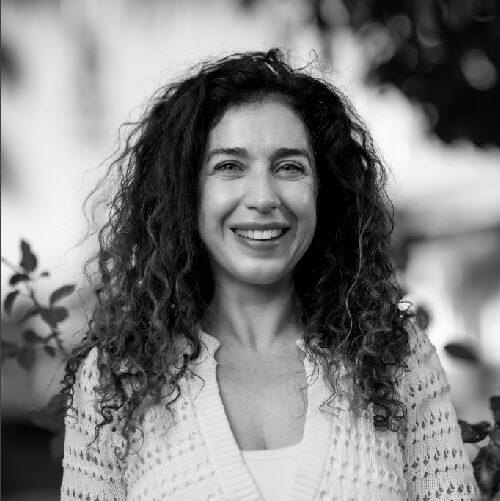
Veruska De Vita has worked in public relations and communications for 26 years. In 2012 she graduated with an MA in creative writing from Wits University. Her obsession with the sea began at an early age and she has always felt at home in the deep blue.
She is a learner free diver and open-water swimmer. In her book she delves into why the ocean calls to us. Along the way she talks to those who find healing and wellness in swimming groups and cold-water immersion, scientists who study complex marine environments, elite athletes who swim super-human distances along our coasts and free divers who plumb the depths with one breath.
What are your early memories of water?
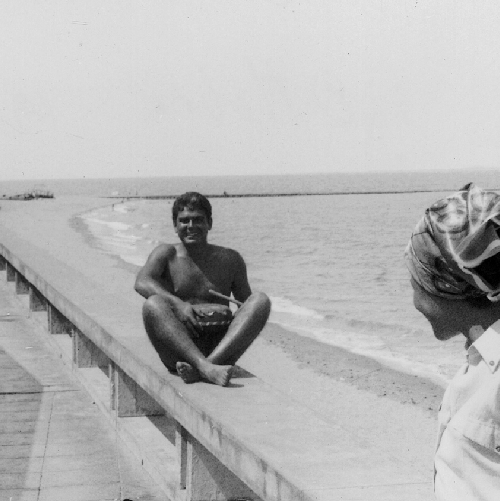
This is one of my earliest memories of water: I am three years old. The water goes tap tap against my thighs. I look at my feet which seem oddly distant and small; my legs refracted by the water. I run my fingers, wrinkled from being in the pool for so long, along my arms feeling the raised peaks on my skin like I’ve grown scales.
Another peak memory is of swimming in Sicily – in the sea and in two perfectly round, unfathomably deep, dark lakes. I must’ve been three or four as my brother was still in nappies, and he’s three years younger than me.
What made you write the book?
My dad has always been a swimmer and I’ve grown up with his stories about the shimmering, mythical, compelling, wondrous deep blue sea. He used to swim from the Sicilian coastline to the island of Mozia and back. He’d freedive for fruits of the sea – octopus, fish, urchins, molluscs. His stories inspired my writing.
What is our human connection to the sea?
This is a big, complex question with lots of different answers both personal and universal. Culture connects us to the sea; so too does ritual, history, origin, food. The ocean is symbolic. Our bodies are made up of water and all the water on the planet is recycled. So we have oceans, seas and rivers inside of us. The sea shapes our physiology – the Bajau, or sea nomads, of Indonesia have bigger than normal spleens because they dive so much.
You interviewed freedivers, extreme swimmers, recreational swimmers and scientists. What did they say about anthropogenic climate change?
Most of them noticed that over the span of a few years they saw increasingly less fish, and more extreme weather. Micro and nanoplastics are causing havoc and are present in fish. The migratory pattern of southern right whales has shifted. The jellyfish population has grown enormously. South Africa’s kelp forests have more young plants and this has altered the ecosystem. There was consensus around rapid and drastic changes to coastlines and oceans.
Why is cold water immersion so good for our health?
It has numerous benefits, but I don’t think it’s for everyone. I think your body either benefits from it, or you just get really really cold. For Amber Fillary, an amazing athlete and ice water diver, cold water is wonderful. It puts her in a good mood, it’s her happy place, she loves how slowly it moves, she can relax in cold water. Others find healing in cold water, both physically and emotionally. Professional swimmer Amica de Jager gets into an ice bath after a major competitive swim because it helps her muscles recover much faster. For many, cold water immersion becomes addictive, in a good way.
You interviewed major role players in the world of freediving. Do they have something in common?
The most obvious characteristic is that freediving is easy for them. Yet, they hone their talent and refine their skills, and they are obsessive about it in that they live, eat, breathe the sport. They are very focused; they’re meticulous in their planning in the run-up to a competition. They deeply understand their body and know how far they can push themselves. They know how to relax their body and mind during freediving, which is not as easy as it sounds!
What would you like readers to take away from this book?
A curiosity for the ocean, a sense of possibility, a deeper respect for the sea.